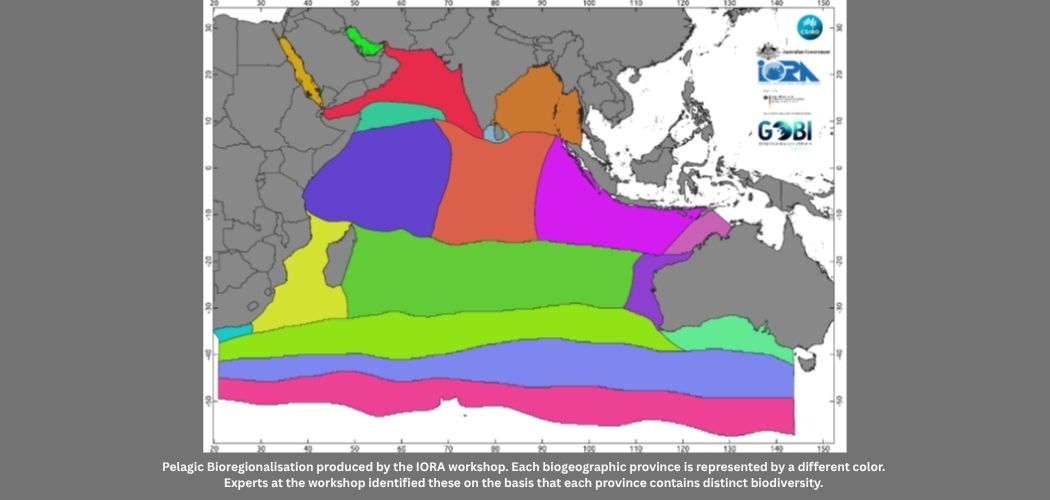
The IORA Workshop Series on the Biogeographic Regionalisation for the Indian Ocean was convened to establish a shared scientific understanding of the region's unique ecological characteristics. Bioregions areas defined by distinct species composition, habitat types, and oceanographic processes, are essential tools for supporting the conservation and sustainable use of marine biodiversity.
The primary purpose of the series was to refine draft bioregionalisation maps and increase the capability of Member States to use this information for management within and beyond national jurisdictions.
The series consisted of two virtual workshops followed by a concluding in-person meeting held from 25–27 March 2024 in Singapore. The events were jointly organized by the IORA Secretariat and Australia’s CSIRO, with support from the Australian Departments of Climate Change, Energy, the Environment and Water and Foreign Affairs and Trade (DFAT). Participation included a robust group of scientists and government experts from IORA Member States and Dialogue Partners.
Key activities centered on reviewing and updating CSIRO’s draft benthic and pelagic bioregionalisation maps to reflect the priorities and expertise of IORA members. Technical sessions addressed critical challenges, including the status of migratory species, the collection of deep-sea biodiversity data, and the integration of bentho-pelagic coupling into regional models. A central theme was the implementation of the BBNJ Agreement, specifically the use of Annex I criteria to identify candidate areas for future protection.
Main outcomes included the finalization of the bioregionalisation maps and a recommendation to establish a Technical Scientific Expert Group to support the IORA Working Group on the Blue Economy. Member States also proposed future capacity-building projects focused on Area-Based Management Tools (ABMTs) and regional data-sharing mechanisms.
This initiative is directly relevant to IORA’s Blue Economy work plan, advancing regional cooperation and sustainable development by providing a unified scientific path forward for ocean governance in the Indian Ocean.